Apparently the light would travel along the black lines in the following, thoroughly confusing diagram. Anyone who knows physics and can explain this using hilarious metaphors is encouraged to contact me directly:The metamaterial, as it is called, produces what's known as negative refraction of visible light. That means light is made to travel in the opposite direction from how it normally should bend when passing through a material. A common example is how a pencil will appear to bend upward when half-submerged in a glass of water. In the new work, researchers make the light appear to bend the other way.

I think it's pretty crucial to note that Marvel comics was way ahead of the curve on this one. This was long ago established as the science behind Sue Storm (the Invisible Woman)'s superpowers. quoth the Marvel Universe
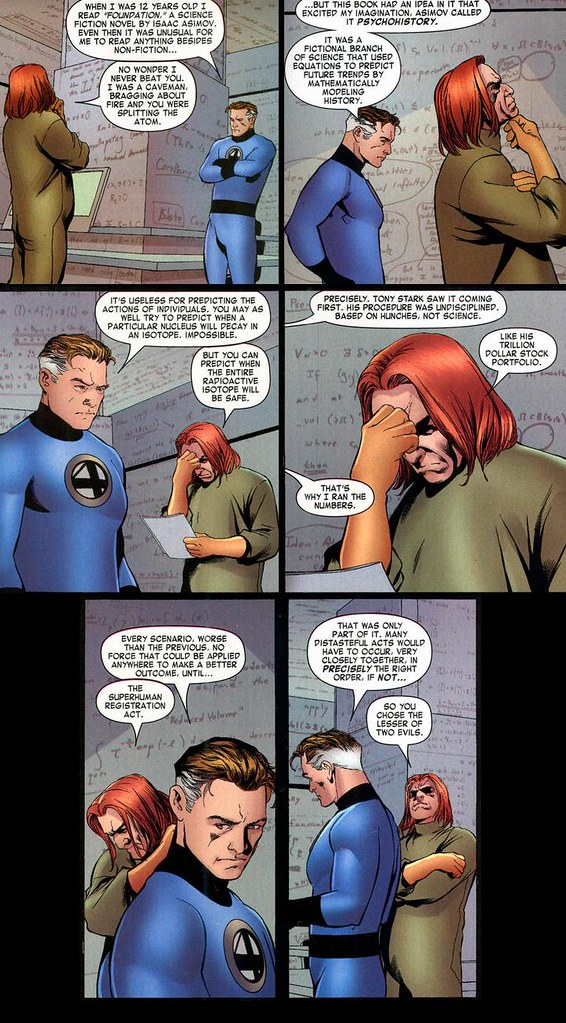
Sue can render herself wholly or partially invisible at will. She can also render other people or objects invisible, affecting up to forty thousand cubic feet of volume. She achieves these feats by mentally bending all wavelengths of light in the vicinity around herself or the target in question, and she somehow does this without causing any visible distortion effects; she also somehow directs enough undistorted light to her eyes to retain her full range of vision while invisible.On a semiserious note: this does encourage my pet theory of the ability of fantastic art to inspire real world creativity. I'll admit that Asimov's psychohistory has whetted my appetite for statistical predictions of cultural and political soothsaying. Certain types of agent-based modeling might be seen as a step towards that. And who introduced me to psychohistory? Who else? Reed Richards:

No comments:
Post a Comment